fellowship 37d left
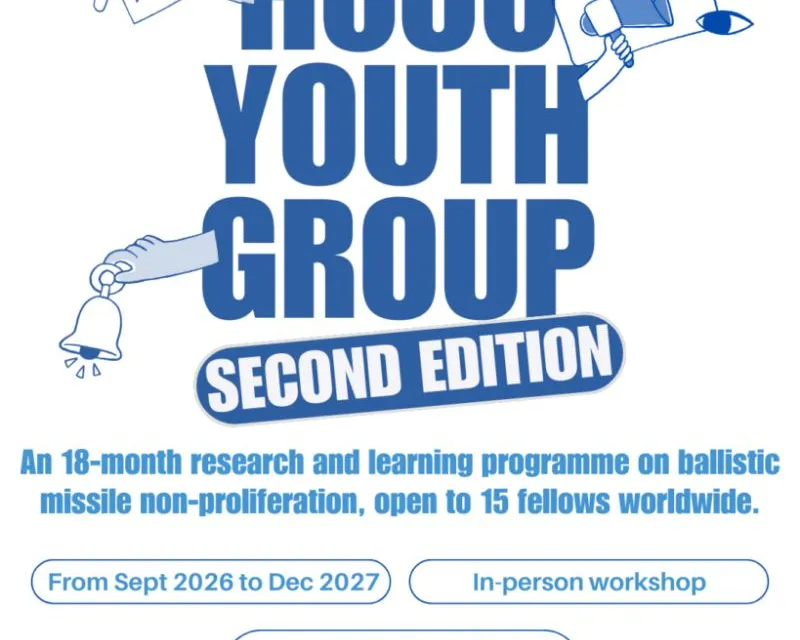
HCoC Youth Group Fellowship 2026–2027
Posted April 1, 2026
Overview
The HCoC Youth Group Fellowship 2026–2027 is a prestigious international programme designed for young professionals, graduate students, and early-career researchers interested in global security, arms control, and non-proliferation. Organized by the Fondation pour la Recherche Stratégique (FRS) with support from the European Union, this fellowship provides a unique platform to engage with leading experts, participate in high-level discussions, and contribute to policy-relevant research on ballistic missile proliferation.
This second edition builds on the success of its inaugural cohort and responds to an increasingly complex global security environment characterized by rapid technological advancements, shifting geopolitical dynamics, and the growing spread of missile technologies.
About the HCoC Youth Group Programme
The HCoC Youth Group is part of a broader initiative supporting the Hague Code of Conduct against Ballistic Missile Proliferation (HCoC), an international effort aimed at promoting transparency, confidence-building, and restraint in missile development.
The programme is structured as an 18-month fellowship that combines:
Virtual learning and discussions
In-person engagement with experts
Independent research and publication
Participants will join a global cohort of 15 fellows, creating a diverse and interdisciplinary learning environment.
Programme Structure and Activities
1. Expert Webinars
Fellows will participate in four thematic webinars scheduled across the programme timeline:
November 2026
February 2027
April 2027
June 2027
Each session includes:
Expert presentations by researchers, diplomats, and practitioners
Moderated discussions
Pre-submitted questions from fellows
2. Virtual Cafés
Optional informal sessions will be held throughout the programme to:
Foster peer interaction and collaboration
Discuss current global developments
Share research progress and ideas
3. In-Person Workshop (Lithuania)
A key highlight of the programme is a three-day residential workshop scheduled for September 2027 in Plokštinė, Lithuania (subject to confirmation).
Key features include:
Expert briefings and discussions
Research exchange sessions
Simulation exercises (e.g., negotiation scenarios or war games)
Guided visit to a former Cold War missile base
All travel and accommodation costs for this workshop are fully covered by the programme.
4. Individual Research and Publication
Each fellow is required to produce an individual research paper as part of the programme:
Selection of a research topic aligned with programme themes
Development of an analytical paper
Contribution to a collective publication edited by FRS
Thematic Pillars
Pillar 1: Technical Dimension
Emerging trends in missile proliferation
Dual-use technologies and space systems
Intersections between civilian and military technologies
Implications for arms control frameworks
Pillar 2: Diplomatic Dimension
Evaluation of the Hague Code of Conduct
International cooperation and policy responses
Challenges in a multipolar geopolitical landscape
Recommendations for strengthening global non-proliferation efforts
Applicants are required to indicate their preferred thematic focus during the application process.
Eligibility Criteria
Who Should Apply
Young professionals
Graduate students (Master's level or above)
Early-career researchers
Required Qualifications
Demonstrated interest in one or more of the following areas:
Ballistic missile technology
Arms control and strategic studies
WMD non-proliferation
Space policy and governance
International law and diplomacy
Regional security studies
Full working proficiency in English
Availability to participate in all programme activities
Age requirement: Applicants must be under 40 years old
Selection Criteria
The selection committee will evaluate candidates based on:
Quality and clarity of application
Relevance of academic or professional background
Geographic diversity
Gender balance
Interdisciplinary representation
Time Commitment
Estimated commitment: 4–6 hours per month
Additional time required for research and workshop preparation
Application Process
Required Materials
Completed online application form
Curriculum Vitae (maximum 2 pages)
Application Questions Include
Motivation for joining the programme
Key challenges in missile proliferation
Contribution to the group
Thematic interest
A key question for experts
All submissions must be in English.