fellowship 13d left
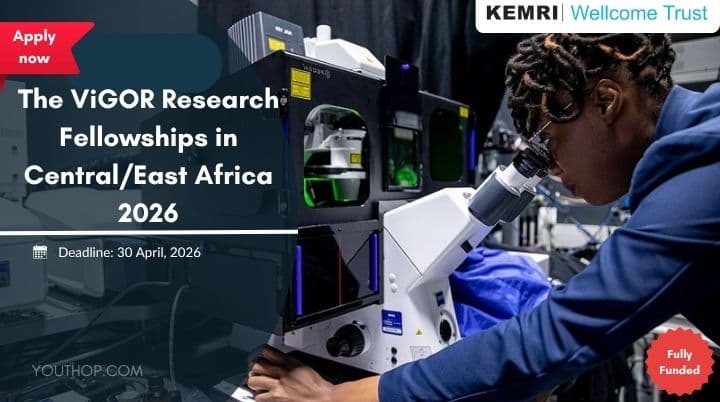
The ViGOR Research Fellowships in Central/East Africa 2026
K
kemri-wellcome.orgThe ViGOR consortium is an NIHR-funded Global Health Research Project bringing together the Mathematics Department of the University of Warwick (UK), KEMRI–Wellcome Trust Research Programme (Kenya), KEMRI-Centre for Virus Research (CVR) (Kenya), the Institut National de Recherche Biomédicale (INRB, Democratic Republic of the Congo), and the Institut National de Recherche pour l’Agriculture, la Pêche et l’Environnement (INRAPE, Comoros).
The ViGOR project aims to strengthen public health systems in the Central/East Africa region by expanding access to genomics, bioinformatics, and outbreak modelling tools during virus outbreaks. The fellowships are an enhanced development of local expertise on the African continent, capable of driving outbreak research and innovation and effective responses to viral disease threats.
Two types of fellowships are available: Genomic Research Fellowships (GRF) focused on sequencing and bioinformatics (5 positions) and Outbreak Modelling Fellowships (OMF) focused on the application of mathematical/epidemiological modelling (5 positions). The fellowships are expected to run for 9-12 months.
The fellows will be invited to join appropriate short courses run by the consortium, e.g., in bioinformatics, infectious disease modelling, and research methods. Supervisors from the home institute will take responsibility for the overall progress of the fellow’s project, with assistance from the assigned mentor with publication and dissemination, and advise on career progression.
In addition to their home institute supervisor, all fellows will be assigned a Mentor from either KWTRP, KEMRI-CVR, INRB, INRAPE, or the University of Warwick to support them in implementing their projects, preparing scientific manuscripts, and policy briefs. The consortium will encourage the fellows to take up opportunities to present their work at regional and international conferences.
Fellow will be integrated into the consortium’s regular scientific discussions to benefit from discussions in this dynamic, multidisciplinary research community. Fellows will be expected to produce reports for policy makers, peer-reviewed publications, and to engage with relevant stakeholders such as government departments involved in disease surveillance and response, and national immunisation technical advisory committees.
The fellowship involves undertaking a few months’ research project that has clear public health significance in one of the two major areas listed (virus genomics or outbreak modelling). Applications include a research project description and a justified budget.
Location:
Africa
Benefits
Successful applicants will receive a budget support of up to:
£10,000 maximum for Outbreak Modelling Fellowships
£15,000 maximum for Genomics Fellowships
Eligibilities
Individuals working in the public health labs/departments/early-career researchers with a Master’s and or PhD qualification (up to 6 years post PhD Award) already have many of the relevant skills to undertake the proposed project.
Full time Affiliation/employment in a recognized academic institution (universities), government /public health labs, or research institution in Eastern or Central Africa